
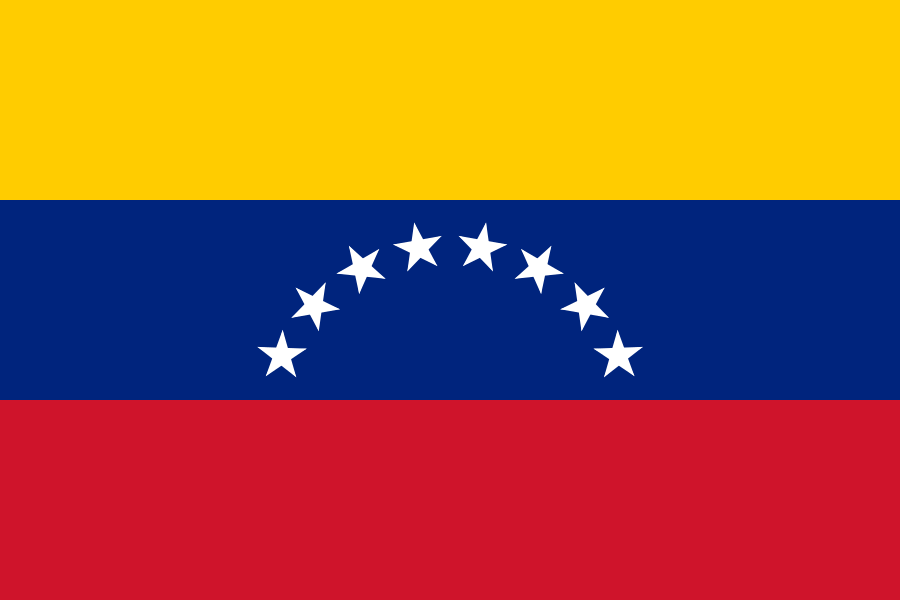
A powerful earthquake struck central Venezuela overnight, trapping an unknown number of people under collapsed buildings as international rescue teams began arriving on Sunday.
The 7.2-magnitude tremor devastated densely populated urban areas, particularly parts of Caracas, with emergency services overwhelmed by calls for help from the early hours. The full scale of the disaster is still emerging, but officials warned that hundreds could be entombed beneath the rubble.
Rescuers Face Urgent Race Against Time
Geologists reported the quake struck at a shallow depth of just 10 kilometres, exacerbating its destructive power across a wide region stretching from the capital to coastal communities. Buildings, many already vulnerable, buckled and disintegrated, sending clouds of dust across neighbourhoods.
Rescue teams, working through the night, clawed at concrete slabs in districts like Los Palos Grandes and Petare, where multi-story apartment blocks and commercial structures had pancaked. The air was thick with the smell of dust and gas, punctuated by the wail of sirens and the shouts of emergency workers.
Families waited anxiously near piles of debris, their faces streaked with dirt and tears, listening intently for any sounds of life from beneath the shattered concrete. Sniffer dogs were deployed, their sharp barks offering brief, desperate glimmers of hope in the grim search.

President Declares State of Emergency
President Nicolás Maduro declared a state of emergency across the affected states, deploying military personnel and ordering all available national resources towards the search and rescue operation. He appealed for international assistance, citing the overwhelming challenge facing the nation’s emergency services.
"We are facing a national tragedy of immense proportions," Maduro said in a televised address early on Sunday, his voice hoarse. "Our priority is to save every life we can, but we need the world's help."
Several countries responded swiftly. Mexico dispatched its renowned urban search and rescue "Topos" team, known for their expertise in earthquake zones, arriving with specialised listening devices and heavy lifting equipment. Chile and Colombia also pledged immediate assistance, sending medical personnel and additional rescue units.
International Aid Pours In Amidst Logistical Hurdles
The United Nations Office for the Coordination of Humanitarian Affairs (OCHA) announced it was mobilising resources and coordinating international aid efforts. A spokesperson confirmed that assessment teams were on the ground, but warned that access to some remote affected areas remained severely difficult due to damaged roads and communication outages.
The earthquake triggered widespread power blackouts and disrupted water supplies, compounding the humanitarian crisis. Hospitals in Caracas reported being overwhelmed with casualties, many suffering from crush injuries, fractures, and severe lacerations. Makeshift triage centres were set up in parks and open spaces.
Eyewitnesses described chaotic scenes in the moments after the tremor. "It felt like the world was ending," said Maria Rodriguez, 45, who escaped her collapsing apartment building in Chacao with her two young children. "Everything shook, then just crashed down. We ran for our lives."
Vulnerability and Past Disasters
Venezuela, situated near the Caribbean tectonic plate, is no stranger to seismic activity, though a tremor of this magnitude is rare. The devastating 1967 Caracas earthquake, which killed more than 200 people and destroyed numerous buildings, serves as a stark historical reminder of the region's vulnerability.
Critics of the government have long warned about the poor state of infrastructure and lax building codes, suggesting that many structures were not adequately prepared for a major seismic event. These concerns are now amplified by the extent of the destruction witnessed across the capital and beyond.
As the initial 72-hour window critical for finding survivors begins to close, rescue teams face the daunting prospect of searching through an estimated half-million tons of rubble. The government has activated its national disaster response plan, but the sheer scale of the devastation suggests a prolonged and arduous recovery effort will be needed in the months ahead.
The full extent of the damage and precise casualty figures are expected to become clearer over the next 48 to 72 hours as communications are gradually restored and more remote areas are accessed by rescue and assessment teams.
Discussion (0)
Sign in to join the discussion.